 Prompt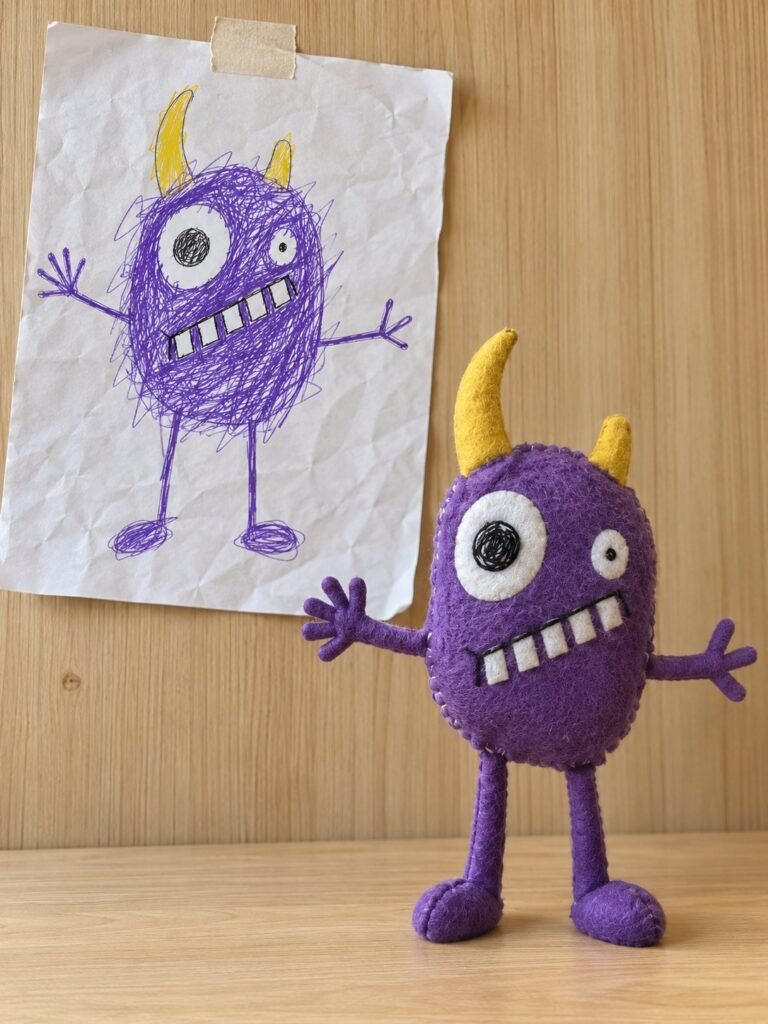
Your Child’s Drawing Becomes a Real Toy
Prompt
{
"subject": "Two things in the same photo: a small child's drawing, taped to a light wood wall, and the plush toy sewn from it, standing on the table right in front. The drawing is a purple monster made of pen scribble: an oval body filled with crossing strokes that run past the outline and spill outside it, TWO uneven yellow horns on top (the left one taller and curved, the right one smaller and straighter), ONE big eye with a scribbled black pupil and ONE small eye with a dot for a pupil, an open crooked mouth with FIVE white rectangular teeth in a line that climbs to the right, two thin arms coming out of the middle of the body, the left hand with FIVE splayed fingers and the right one with THREE, and TWO long thin legs ending in rounded feet",
"faithfulness_rules": "The toy is a copy of the drawing, and the one thing it must NOT do is fix it: it keeps the SAME counts - two uneven horns, one big eye and one small eye, five teeth, five fingers on one hand and three on the other, two legs - the same asymmetry, the same gangly proportions and the same crooked line of the mouth. Nothing is evened out, nothing is centred and nothing is added: if the drawing has no nose, the toy has no nose; if one horn is bigger than the other, it stays bigger",
"action": "Nothing is happening: the toy stands still on the table, arms open in the same pose as the drawing",
"scene": "A light wood wall with a vertical grain behind; on it, held by a single piece of masking tape at the top, a crumpled sheet of white paper with creases and uneven edges; the table in the foreground is the same light wood. Nothing else appears in the frame",
"composition": "A vertical photo in 3:4 proportion. The sheet of paper takes the top half of the frame and the left side, slightly tilted; the toy stands on the table in the foreground, taking the bottom half and the right side, with the tips of its horns at around 35% of the height. Both show whole and side by side, and you can compare them at a glance",
"camera": "Camera at table height, straight on, lens equivalent to 50 mm; the toy in sharp focus and the drawing slightly softer, with no heavy blur",
"lighting": "Diffuse natural window light coming from the left, a short soft shadow of the toy on the table and a thin shadow of the paper on the wall; no hard light and no specular gloss",
"color_palette": "Purple for the body, yellow for the horns, white for the felt of the eyes and the teeth, light wood for the wall and the table, and white for the paper; natural saturation",
"materials": "The drawing is purple ballpoint pen and yellow crayon on crumpled copy paper; the toy is purple plush fabric with short visible pile, with eyes and teeth in cut white felt, horns in yellow felt, a mouth embroidered in black thread, visible seams at the joins and uneven stuffing",
"details": "The COUNTS are the product of this prompt, and they have to match between the drawing and the toy: two uneven horns, one big eye and one small eye, five rectangular teeth, five fingers on the left hand and three on the right, two legs. Preserve as well what gives away the handmade work: the visible stitching, the uneven stuffing and the slight lean of the toy as it stands",
"negative_prompt": "letters, words, numbers, a signature on the paper, a sewn-in label on the toy, a symmetrical toy, matching eyes, limbs of the same size, corrected anatomy, one finger more or less than the drawing, one tooth more or less than the drawing, a generic cute cartoon character, a factory-made toy, a perfect finish, plastic gloss, a studio background, a catalogue table, watermark, logos, real brands, likeness to a character from a real franchise, AI artefacts"
}
How to use
The drawing on the fridge becomes a real toy - and the trick is what the AI must NOT fix. It tends to "tidy up": it evens out the legs, makes the eyes match, turns it into a generic cute character. The toy comes out pretty and stops being your child's drawing. It works in ChatGPT, Gemini and NanoBanana. 1. Photograph the whole drawing, straight on and in window light, with no shadow of your hand on the paper. 2. Rewrite subject with what is in the drawing: how many legs, how many fingers, how many teeth, which colours. Those numbers are what hold the fidelity. 3. Do not touch the preservation block: it is what stops the AI from correcting the anatomy. 4. Compare the toy against the drawing in the image that comes back. If any number changed, repeat it in details and generate again. 5. Change the material if you like - felt, crochet or clay - and keep the rest. Tip: ask for a photo of the toy on its own too, with no drawing behind it. That is the one for whoever will sew it for real.
Works with
ChatGPT
Gemini
NanoBanana
Rate this prompt
📖 From the Prompteiro blog
See all posts →
Colourise Black and White Photos With AI: A GuideImages · September 7, 2026

AI Headshots for LinkedIn: The Complete GuideImages · September 4, 2026
Pet Photo Prompts: How to Get It Right First TimeImages · September 1, 2026

What ChatGPT Keeps of Everything You TypeCourses · September 1, 2026

How to Use Artificial Intelligence on Your PhoneCourses · August 28, 2026

Why ChatGPT Gets Things Wrong and How to Check ItCourses · August 24, 2026

How to Create an AI Image From Your Own PhotoCourses · August 19, 2026

AI for Studying: Exams, Tests and LanguagesText · August 18, 2026

Free AI: What You Can Do Without Paying AnythingCourses · August 12, 2026