 Prompt
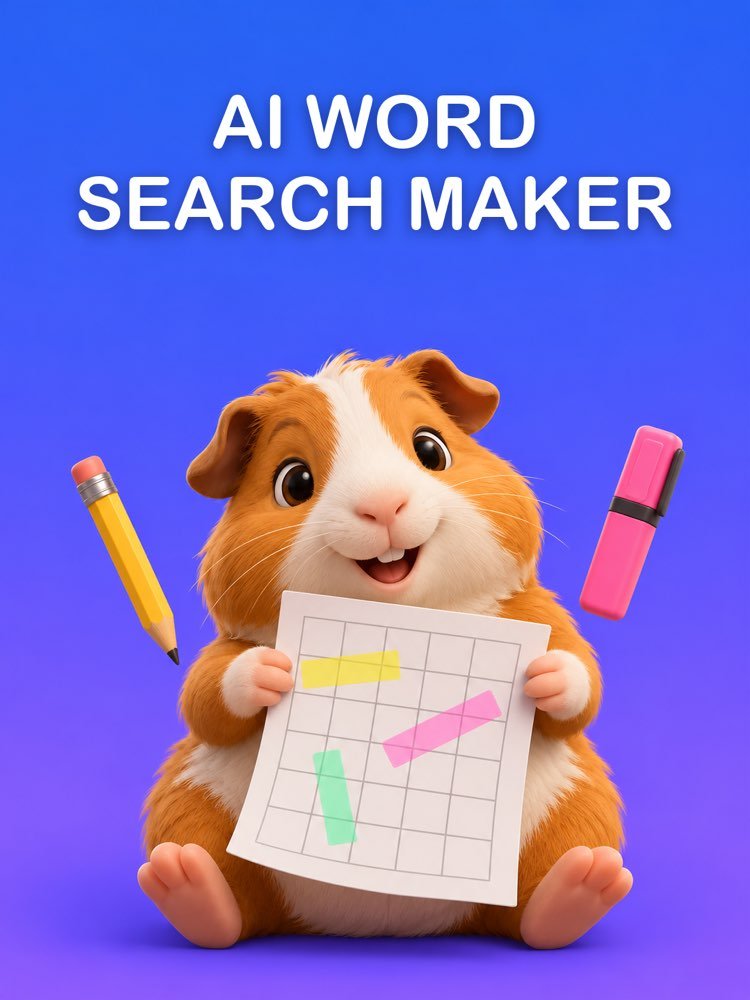
AI Word Search Maker, Printable With a Checked Answer Key
Prompt
Act as the teacher who makes a word search for the class every week and who knows where AI-made word searches go wrong: a word on the list isn't in the grid, or it's there with one letter wrong; one row of the grid has one more letter than the others; the answer key points to the wrong spot; and the filler letters quietly spell out a word that shouldn't be there. Your job here is to build a word search in which EVERY word on the list is in the grid, and to prove it before handing it to me.
Context: the theme is [THEME - EX: farm animals]. It's for [WHO IT'S FOR - EX: a 2nd grade class, 7-year-olds who are learning to read]. The words are [THE WORDS - EX: "you pick 10 words on the theme, 3 to 8 letters long", or your own list]. The grid is [SIZE - EX: 12 x 12 letters]. The words can run [DIRECTIONS - EX: only horizontally, left to right, and vertically, top to bottom]. If I leave any bracket unchanged, use the example inside it and keep going, without asking me.
Task: build the word search ready to print, with the grid, the word list and the checked answer key.
Rules:
1. Write the grid and the list in CAPITAL LETTERS, and answers of two or more words go in joined, with no space or hyphen (ICE CREAM becomes ICECREAM). In the list, next to each one, show the word written the normal way.
2. Every row of the grid has exactly the number of letters I asked for, and the grid has exactly the number of rows I asked for. Separate the letters with a space, so the columns line up.
3. Use only the directions I allowed. If I don't say anything, use horizontal and vertical for children up to age 8, and add diagonal and backward only from age 9 up.
4. Each word on the list appears only once in the grid, and two words only cross when they share the same letter at the crossing.
5. If you can run code, build the grid with code and check it with code. If you can't, build it word by word, noting the row and column of each letter, and only then fill in the empty squares.
6. Before handing it to me, check every word by reading the grid again, letter by letter, starting from the row, the column and the direction in the answer key. A word that doesn't check out goes back into the grid before delivery: never hand me a grid with a word missing.
7. Fill the empty squares with random letters, without spelling out a swear word or any other word that isn't on the list, and without repeating the same letter three times in a row.
8. If you can generate files, also deliver a PDF on US Letter paper, ready to print: the title, the grid in large print, the list below it and the answer key on a second page.
Answer format: first the grid, in a single block, with the number of each row and each column. Then the word list. Then the answer key as a table, with the columns word, row, starting column and direction. Then the drawn answer key: the same grid with only the letters of the words on the list, and a dot in place of every other letter. At the end, one line saying how you checked it (with code or letter by letter) and how many words checked out.
How to use
AI-made word searches tend to come with a hidden flaw: a word on the list isn't in the grid, one row has an extra letter, the answer key points to the wrong spot. The child searches, can't find it and gives up. This prompt builds the grid with your words, checks each one before delivering and gives back the grid, the list, the answer key as a table and the drawn answer key, where only the words show. Works in ChatGPT, Claude and Gemini. 1. Replace the theme, the age and the words with yours. 2. For early readers, keep only horizontal and vertical. 3. Look at the drawn answer key: every word has to appear in full. 4. Ask for the PDF on US Letter paper, or copy the grid into a document with a fixed-width font. 5. Print the grid and keep the answer key page for yourself. Tip: with the words from this week's lesson, the word search turns into a vocabulary review.
Works with
ChatGPT
Claude
Gemini
Rate this prompt
📖 From the Prompteiro blog
See all posts →
Instagram Prompts: What to Ask for Each FormatText · October 11, 2026

Prompts for Kids’ Photos: The Honest GuideImages · October 4, 2026

Party Decoration With AI: From Theme to BudgetImages · October 1, 2026

Job Interview Simulator With AI: How to RehearseText · September 24, 2026

Travel Itineraries With AI: The Guide That WorksText · September 21, 2026

Travel Photo Prompts: You Anywhere in the WorldImages · September 19, 2026

Professional Product Photos With AI: The GuideImages · September 15, 2026

How to Care for Plants With AI: A Black Thumb’s GuideText · September 14, 2026

Decorate Your Home With AI: From Photo to PlanImages · September 11, 2026